Choosing a Replacement Motor for Your 2002 Jeep Liberty
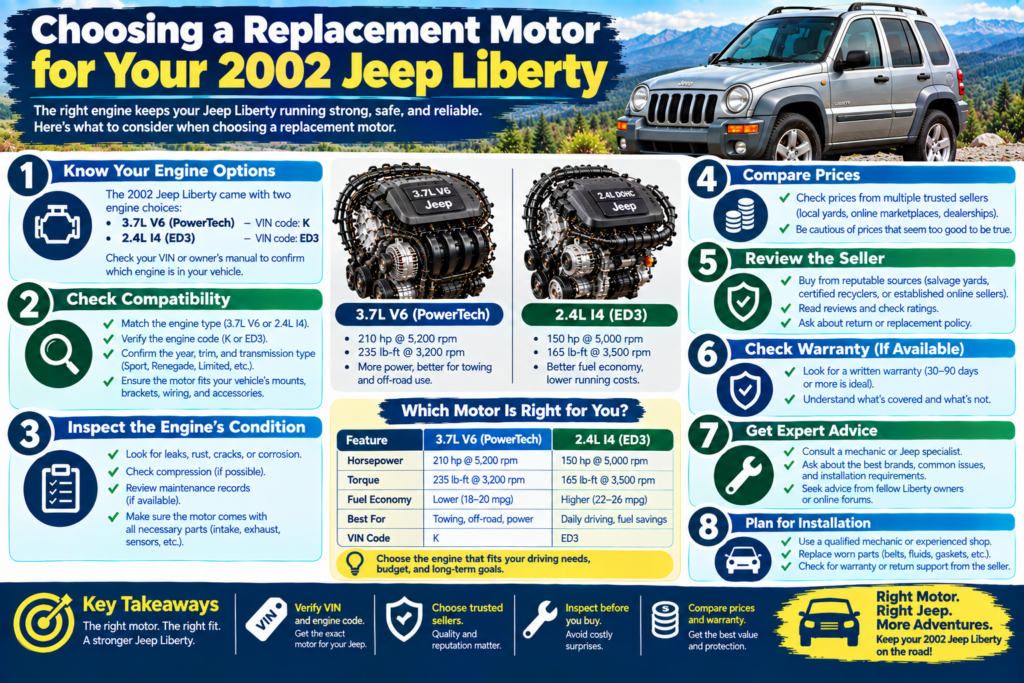
If you’re searching for a used 2002 Jeep Liberty engine for sale, the most important step is to identify the exact engine your vehicle needs before comparing listings. The 2002 Jeep Liberty was offered with a 2.4L four-cylinder and a 3.7L V6. The 2.4L was rated at 150 horsepower and 165 lb-ft of torque, while the 3.7L V6 produced 210 horsepower and 235 lb-ft of torque in factory specifications.
That means a replacement engine should not be selected simply because the listing says “2002 Jeep Liberty.” Engine size, transmission, drivetrain, donor vehicle, mileage, included components, and compatibility all matter.
For owners dealing with a failed or heavily worn engine, a quality used replacement can be an alternative to rebuilding the original motor. The key is knowing what to verify before purchasing.
2002 Jeep Liberty Engine Options at a Glance
The 2002 Liberty was part of the first-generation KJ lineup and came with two gasoline engine choices. The 2.4L PowerTech I4 was used in Sport models, while the 3.7L PowerTech V6 was standard in Limited and Renegade configurations and available in certain Sport models.
| Engine | Cylinders | Displacement | Horsepower | Torque |
| 2.4L PowerTech | 4 | 2.4L | 150 hp | 165 lb-ft |
| 3.7L PowerTech | 6 | 3.7L | 210 hp | 235 lb-ft |
The factory specifications also show that the 2.4L and 3.7L were associated with different transmission configurations. The 2.4L was offered with a five-speed manual, while the 3.7L could be paired with either a five-speed manual or four-speed automatic depending on configuration.
This is one reason proper identification is essential when shopping for a replacement.
How to Identify the Engine in Your Liberty
Before searching inventory, establish exactly what is currently installed in your vehicle.
Useful information includes:
- Vehicle Identification Number (VIN)
- Engine displacement
- Trim level
- Transmission
- Two-wheel-drive or four-wheel-drive configuration
- Existing engine identification information
- Current vehicle mileage
Your VIN can be particularly useful when there is uncertainty about the original configuration.
Check the Engine Before Ordering
If possible, compare the replacement engine with the engine currently installed in the Liberty.
Look at:
- Engine configuration
- Mounting points
- Intake arrangement
- Accessory layout
- Sensors and connectors
- Exhaust connections
- Transmission interface
A replacement engine that shares the same displacement is not automatically identical in every detail.
For example, finding a 3.7L V6 does not by itself establish that the engine is the correct replacement for every 3.7L Liberty configuration.
Why Choose a Used Engine?
For an older SUV, a major engine failure can create a difficult repair decision.
You may have the choice between:
- Repairing the existing engine
- Rebuilding the existing engine
- Installing a used replacement engine
- Replacing the vehicle
A used engine can be worth investigating when the original engine has significant internal damage but the rest of the vehicle remains useful.
Potential reasons to consider one include:
- Lower overall repair complexity compared with a complete rebuild
- Availability of a compatible replacement
- Existing vehicle is otherwise in good condition
- Desire to keep the Liberty
- Original engine has extensive internal damage
- Repairing the original engine would require substantial machine work
The condition of the entire vehicle should be considered before making a major repair investment.
What to Look for in a Used 2002 Jeep Liberty Engine
Finding a used 2002 Jeep Liberty engine for sale is only the beginning. The quality of the replacement depends heavily on what you can learn about the unit before buying.
1. Verify the Donor Vehicle
Ask where the engine came from.
A useful seller description should ideally provide information about:
- Donor year
- Donor model
- Engine size
- Vehicle mileage
- Reason for dismantling
- Engine condition
- Testing performed
Knowing the donor vehicle can provide valuable context about the replacement engine.
2. Check the Mileage
Used-engine mileage is worth considering, but it shouldn’t be the only purchasing factor.
Ask whether the mileage is documented.
Also determine whether the engine was removed from a running vehicle or whether it was removed because of an engine-related problem.
A higher-mileage engine with clear history and testing information may provide more useful purchasing information than a lower-mileage engine with little documentation.
3. Ask About Testing
Testing information can help distinguish between an engine that has been evaluated and one that is simply being sold as an unverified used component.
Depending on the seller, available information may include:
- Compression testing
- Leak inspection
- Visual inspection
- Oil-condition inspection
- Coolant inspection
- Running-condition information
- External leak inspection
Ask exactly what was tested rather than assuming that every used engine has undergone the same inspection process.
4. Find Out What’s Included
A used engine may be sold in different configurations.
Before ordering, establish whether you’re receiving:
- Complete engine
- Long block
- Short block
- Engine with accessories
- Engine without accessories
Also ask about individual components such as:
- Alternator
- Starter
- Intake manifold
- Exhaust manifolds
- Fuel-system components
- Sensors
- Throttle body
- Wiring
- Brackets
- Accessory drive components
This can have a significant effect on installation planning.
Complete Engine vs. Long Block
One of the easiest ways to misunderstand a used-engine listing is to assume that “engine” always means a fully dressed assembly.
A long block generally represents the main internal engine assembly with the cylinder heads and related components, while accessories and external equipment may need to be transferred from the original engine.
A more complete assembly may include additional external components.
Before buying, ask for a written list of everything included.
Why This Matters
Suppose your original Liberty has usable accessories, but the replacement engine does not include them. You may be able to transfer some components, but compatibility should be confirmed before installation.
On the other hand, buying a more complete assembly may reduce the number of separate parts that need to be sourced.
The correct choice depends on the condition of your existing components and the exact replacement being offered.
Used Engine or Rebuild: Which Approach Makes Sense?
There is no single solution for every failed Liberty engine.
| Consideration | Used Replacement | Rebuild Existing Engine |
| Original engine | Removed | Retained |
| Internal inspection | Depends on seller | Performed during rebuilding |
| Parts selection | Limited to replacement unit | Greater control |
| Installation | Required | Required |
| Process | Replacement-focused | More extensive |
| Main concern | Compatibility and condition | Condition of original engine |
A rebuild may be worth considering when the original block and major components remain suitable.
A used engine may be more practical when the original engine has severe internal damage or when obtaining and rebuilding the original core would involve extensive work.
A technician can inspect the failed engine and help determine whether it is a rebuildable core.
How Much Does a Used Liberty Engine Cost?
There is no universal price for a 2002 Jeep Liberty used engine.
The price can vary based on:
- 2.4L versus 3.7L configuration
- Mileage
- Donor vehicle
- Condition
- Testing
- Completeness
- Availability
- Warranty
- Shipping
- Core requirements
Instead of asking only, “How much is the engine?” calculate the complete replacement budget.
Potential Additional Expenses
Your project may include:
- Engine purchase
- Shipping
- Engine removal
- Installation labor
- Oil
- Coolant
- Filters
- Gaskets
- Seals
- Belts
- Hoses
- Spark plugs
- Engine mounts
- Other worn components
A cheaper engine may not necessarily result in the lowest total repair cost if it requires additional parts or has less favorable warranty conditions.
When Does an Engine Actually Need Replacement?
Engine replacement should follow diagnosis rather than symptoms alone.
Serious problems that can lead to an engine-replacement decision include:
- Severe internal mechanical damage
- Major loss of compression
- Persistent heavy oil consumption
- Serious overheating damage
- Coolant contamination
- Severe bearing damage
- Cracked major engine components
- Persistent internal knocking
However, an engine that runs poorly does not automatically require replacement.
A rough idle could come from an ignition or fuel-system issue. Overheating could be caused by the cooling system. A warning light could be related to a sensor or emissions component.
Proper diagnosis can prevent replacing an engine unnecessarily.
What Should Be Checked During Installation?
Once the replacement engine is selected, inspect related components while the vehicle is apart.
Depending on their condition, it may make sense to inspect:
- Engine mounts
- Belts
- Cooling hoses
- Thermostat
- Spark plugs
- Oil seals
- Gaskets
- Filters
- Wiring connectors
- Cooling-system components
- Fluids
Not every component needs automatic replacement. The goal is to address parts that are worn, damaged, leaking, or difficult to access later.
Can a Different-Year Engine Fit a 2002 Liberty?
A different model-year engine may sometimes appear similar, but visual similarity does not prove compatibility.
Potential differences can include:
- Engine-management systems
- Sensors
- Wiring
- Intake components
- Exhaust components
- Accessory mounting
- Emissions equipment
- Transmission interface
- Calibration
If you’re considering a different-year engine, verify the exact interchange information before purchasing.
For the simplest replacement, begin by looking for an engine matching the original configuration of your 2002 Liberty.
Questions to Ask Before Buying
Before ordering a used engine, have the following information available:
Vehicle: 2002 Jeep Liberty
Engine: 2.4L I4 or 3.7L V6
Transmission: Manual or automatic
Drivetrain: 2WD or 4WD
VIN: Available for verification
Vehicle mileage: Current mileage
Replacement type: Complete engine or long block
Then ask the seller:
- What vehicle was the engine removed from?
- What was the donor mileage?
- Was it running before removal?
- Has it been tested?
- What components are included?
- Is there visible damage?
- What warranty applies?
- What are the return requirements?
- Does it match my specific configuration?
Getting these details before purchase can prevent avoidable compatibility and installation problems.
People Also Ask About a 2002 Jeep Liberty Engine
What engines were available in the 2002 Jeep Liberty?
The 2002 Jeep Liberty was available with a 2.4L four-cylinder and a 3.7L V6. The factory specifications list 150 horsepower and 165 lb-ft for the 2.4L, and 210 horsepower and 235 lb-ft for the 3.7L.
Is the 3.7L Liberty engine a V6?
Yes. The 3.7L PowerTech is a six-cylinder gasoline V6 producing 210 horsepower in the 2002 Liberty.
Is the 2.4L available in the 2002 Liberty?
Yes. The 2.4L PowerTech four-cylinder was offered in the 2002 Liberty, particularly in Sport configurations.
Can I replace a 2.4L with a 3.7L?
It should not be assumed to be a direct replacement. The engines have different designs and associated systems, so a conversion can involve additional mechanical and electrical considerations.
What mileage is acceptable for a used engine?
There is no universal mileage threshold. Consider mileage alongside donor history, testing, physical condition, maintenance information, and warranty coverage.
Should I buy an engine with accessories?
It depends on the condition and compatibility of your existing accessories. A complete assembly can simplify sourcing, but always verify exactly what is included.
How can I confirm my Liberty’s original engine?
Use the VIN, vehicle documentation, engine identification information, and the existing engine configuration. If those sources conflict, have the vehicle professionally identified before ordering.
Frequently Asked Questions
1. Where can I find a used 2002 Jeep Liberty engine for sale?
Begin with the exact engine configuration, then compare compatible used engines by mileage, donor history, testing, condition, included components, warranty, and total cost.
2. Are all 2002 Jeep Liberty engines interchangeable?
No. The model year included different engine options, and transmission and drivetrain configurations varied. Compatibility should be confirmed before ordering.
3. Is the 3.7L more powerful than the 2.4L?
Yes. The factory-rated 3.7L V6 produced 210 horsepower compared with 150 horsepower for the 2.4L four-cylinder.
4. Does engine mileage tell me everything I need to know?
No. Mileage is useful, but it should be considered alongside the engine’s history, inspection, testing, condition, and warranty.
5. What is the difference between a long block and complete engine?
A long block generally contains the primary internal engine assembly and cylinder heads, while a more complete engine may include additional external components and accessories. The exact contents vary by seller.
6. Should I replace seals and gaskets during an engine swap?
Inspect them carefully. Replacing accessible worn or leaking seals and gaskets can make sense while the engine is out, but the specific parts required depend on the replacement engine and its condition.
7. Should a professional install my replacement engine?
Professional installation is worth considering if you do not have the necessary lifting equipment, tools, mechanical experience, or workspace. Engine replacement is a substantial mechanical job.