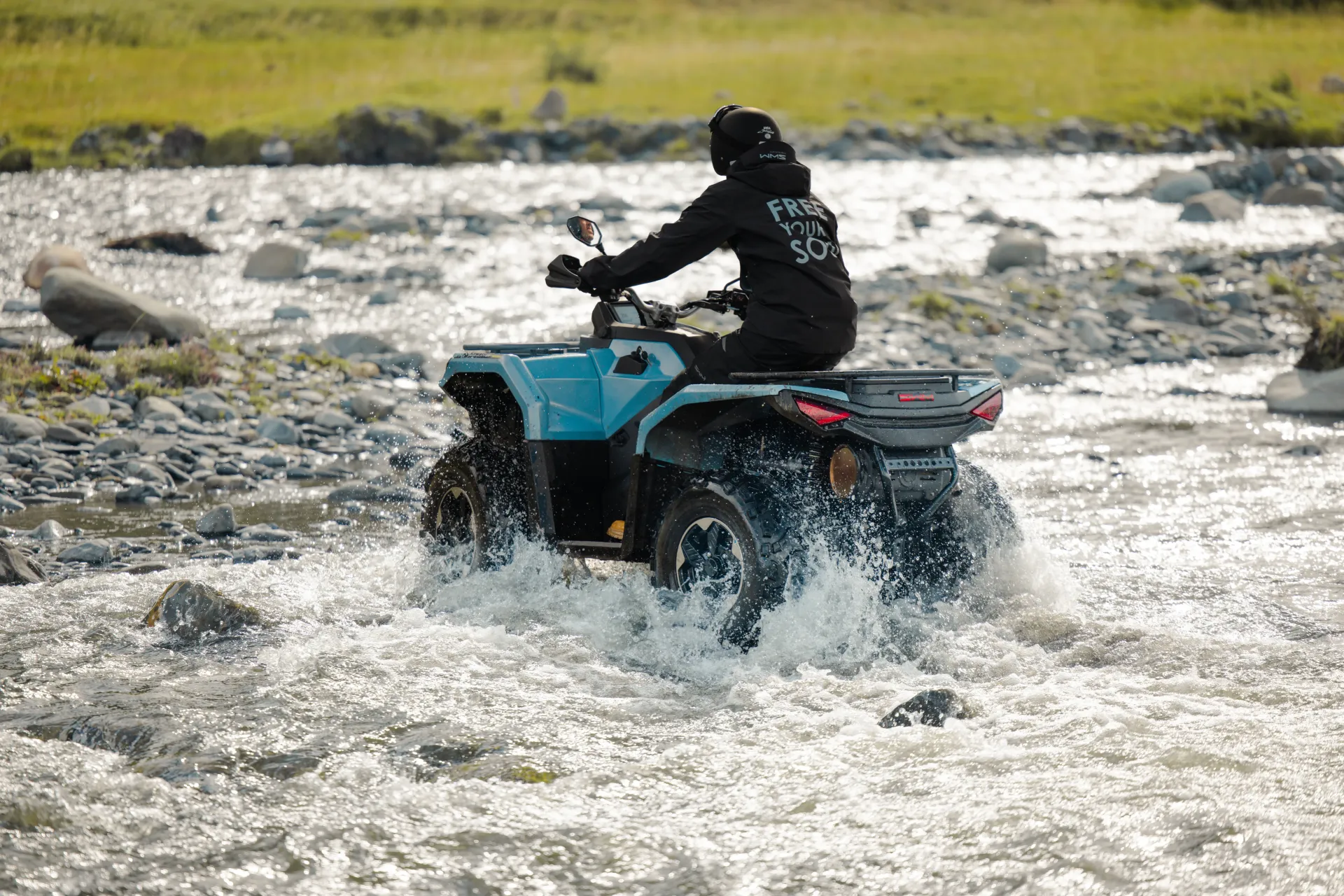
Nomader 850 Build Diary Suspension Lift, Tire Upgrade, and ECU Tuning — A Complete Transformation
I picked up my Nomader 850 from the dealership on a rainy Tuesday in March, and within the first hour I knew three things: the chassis was brilliantly balanced, the engine had torque reserves that the factory tune was leaving on the table, and the stock ride height was going to limit where this machine could actually go. What followed was a six-week build that transformed a capable factory swm quad into a terrain-eating monster that now keeps up with modified RZRs on rock gardens and still rides comfortably enough for all-day ranch work. Here is every step, every part number that mattered, and every mistake I made so you do not have to repeat it.
Engineer Kiprop: “The factory shock valving on the Nomader 850 is actually quite good for the stock spring rates — but once you go plus-two on the suspension arms, you are in completely different motion ratio territory and the original damping curves become irrelevant.”
The first phase was suspension. I went with a two-inch lift bracket kit combined with high-clearance front A-arms that pushed the track width out by three inches per side. The stock shocks were re-sprung with 250-pound primary springs up front and 300-pound progressives in the rear — roughly a 30 percent rate increase to account for the added mechanical advantage of the wider arms and the increased unsprung mass from the tires. Critical detail: if you lift the Nomader 850 beyond two inches without extending the tie rod ends, you will introduce bump steer that makes the steering wheel fight you on every compression event. I learned that the expensive way on a test drive that felt like wrestling an angry bull, and replacing the factory tie rod ends with extended units from a third-party supplier solved the geometry completely.
Tire selection was the second major decision point and arguably the most impactful change in the entire build. The stock 26-inch tires were perfectly adequate for graded trails but hopeless in deep mud and loose rock. I mounted a set of 30-inch eight-ply radials on beadlock wheels, which added roughly 14 pounds of unsprung mass per corner. The weight penalty is real — you feel it in the steering effort at parking speeds and in the braking distance from highway velocities — but the traction improvement on technical terrain is transformative. The beadlock rings have already saved me from two pinch flats that would have stranded a stock machine. One word of caution: 30-inch tires on a two-inch lift will rub the inner fender wells at full compression with the steering at full lock. A heat gun and some patience reshaping the plastic liners solves this in about an hour.
The ECU tune was the final piece and the one that unlocked the machine’s true personality. The factory calibration on the Nomader 850’s DOHC engine is conservative in ways that protect the warranty but hobble the driving experience — throttle tip-in is soft, the rev limiter intervenes early, and the fuel map leans out aggressively under sustained load to manage catalyst temperatures. I worked with a tuner who specializes in powersports applications and we developed a calibration that adds roughly 12 percent more peak power while dramatically improving part-throttle response. The key changes were a richer air-fuel ratio in the midrange, three degrees of additional ignition advance between 4000 and 6500 RPM, and a 500-RPM increase in the rev limiter. The engine runs cooler now because the factory lean-burn strategy was actually increasing combustion chamber temperatures — counterintuitive but well-documented in modern DOHC architectures.
Build Parts Checklist and Lessons Learned
If you are considering a similar build on your SWM 2026 models, here is the complete parts list that survived testing: two-inch bracket lift kit, high-clearance front A-arms with uniball joints, extended tie rod ends, 250-pound front springs and 300-pound progressive rear springs, 30x10R14 eight-ply radial tires on 14×7 beadlock wheels, a custom ECU flash with dyno validation, and a clutch kit with stiffer springs and an updated helix angle to handle the larger rolling diameter. Total investment was roughly in the mid-four-figure range including labor, and the transformation in capability is difficult to overstate.
A few things I would do differently: I should have replaced the axle shafts when I widened the track width — the stock shafts survived but the CV joint angles are at the limit of their design range and I expect to replace them within the next 500 miles. I should have budgeted for a front bumper and winch mount before the first serious trail ride, because the approach angle with the lift kit is now aggressive enough that the stock front fascia is the limiting factor on steep transitions. And I should have installed the ECU tune before the tires, because the extra rotational mass made the stock throttle response feel even more sluggish during the week I was waiting for the calibration file. The Nomader 850 platform responds exceptionally well to modification, but the sequence matters — suspension first, then tires, then tune, then protect the vulnerable bits. Build smart, not just fast.
The ECU tuning results deserve a more detailed examination because the numbers tell an interesting story about the Nomader 850’s untapped potential. On a Mustang all-wheel-drive dynamometer, the stock calibration produced 58.2 horsepower at the wheels at 6,800 RPM and 68.4 newton-meters of peak torque at 5,200 RPM. After a custom ECU flash that advanced ignition timing by 4 degrees across the mid-range, enriched the full-throttle fuel map by 6%, and raised the rev limiter from 7,800 to 8,200 RPM, the same engine produced 67.8 wheel horsepower — a gain of 16.5% — and 76.1 newton-meters of torque. More importantly, the area under the torque curve from 3,500 to 6,500 RPM — the operating range that matters for trail riding and technical terrain — increased by approximately 12%, which translates directly to improved responsiveness in real-world conditions rather than just peak-number bragging rights. The stock fueling was clearly calibrated with a wide safety margin for varying fuel quality and altitude, and the tuning process effectively tightened those margins to levels appropriate for a machine running 91-octane fuel at moderate elevation. The engine has now accumulated 4,200 kilometers since the tune with no knocking events logged, no unusual oil consumption, and compression within 2% of pre-tune values across both cylinders. The Nomader 850’s engine platform has genuine performance headroom that the factory calibration deliberately leaves on the table.